Beginner's Guide to Scuba Diving in Tenerife
The first breath you take underwater feels wrong. Your lungs hesitate for a second because your brain is screaming that you are six meters beneath the Atlantic Ocean and this should not work. Then the regulator hisses, cool dry air fills your chest, and your nervous system suddenly realizes you are fine. Trying scuba diving tenerife for beginners is one of the easiest ways to experience that shift, largely because the island pairs dramatic volcanic topography with surprisingly forgiving coastal entries.
People often ask me if the Canary Islands are too rough for a first timer. It makes sense why they wonder. You look out from a windswept cliff in Costa Adeje, watch the Atlantic swells crash against black basalt boulders, and think there is no way a novice belongs down there. Yet tucked along the southern and western shores are dozens of volcanic coves where the water sits as calm as a swimming pool. This guide covers how to get started without wasting money, what to expect on day one, and how to stay comfortable when the ocean feels foreign.
Book your scuba diving tenerife experience:
Can You Scuba Dive in Tenerife Without Any Experience?
Yes. You do not need a certification, and you do not need to spend weeks studying physics before you go. The standard entry point is an introductory program usually called a Try Dive or Discover Scuba Diving. A certified instructor walks you through basic hand signals, shows you how to clear water out of your mask, explains how pressure affects your ears, and then stays within arm's reach the entire time you are down.
Most beginners start right from the shore. You walk into ankle-deep water on a sloping sandy beach, put on your fins, slip your mask over your face, and float on the surface while you get used to breathing through your mouth. Once you give the instructor an okay sign, you slowly deflate your vest and sink a couple of feet down. It is quiet. The surface world disappears completely, replaced by the crackling sound of parrotfish chewing algae off volcanic rock.
You do need basic swimming skills. If you panic the second your feet leave the sand in deep water, spend an afternoon practicing with a snorkel first. Checking out a complete guide to snorkeling in Tenerife can help you build confidence on the surface before strapping twenty kilograms of gear onto your back. Instructors are patient, but they cannot swim for you.
Note: If you take daily prescription medications or have a history of asthma, heart trouble, or ear surgery, bring a signed clearance form from your doctor before booking. Dive centers in Spain adhere strictly to medical screening laws.
Tenerife Scuba Diving Water Temperature and Seasons
The water here does not feel like the Caribbean. It is the open Atlantic, cooled by deep-sea currents and the trade winds that brush past northwest Africa. The tenerife scuba diving water temperature sits at roughly 19 degrees Celsius in February and climbs to around 23 or 24 degrees by late September. You will always wear a wetsuit.
In mid-winter, shops will hand you a 7mm neoprene suit, often with an attached hood or a short under-vest. It feels bulky when you walk down the slipway like an awkward rubber penguin, but once you submerge, the cold barely registers. By August, a 5mm suit does the job nicely. Visibility fluctuates between 15 and 30 meters throughout the year, meaning you can often look up from the seabed and watch dive boats bobbing overhead in high definition.
Planing your calendar matters more for topside comfort than sea conditions. Winter brings calm seas to the south, though the wind can whip across exposed northern bays. Autumn is the sweet spot. The crowds thin out after August, the ocean reaches its warmest point of the year, and marine life congregates closer to shore before the winter storms stir up deeper water.
The Best Scuba Diving Tenerife for Beginners: Where to Go
Not all dive sites are suitable for someone who has never touched a regulator. You want protected bays with zero current, gentle sand entries, and plenty of shallow marine life to distract you from overthinking your breathing. The south side of the island holds nearly all the top training bays because Mount Teide blocks the persistent northeast trade winds.
These are the standout locations for your first descent:
- Abades Bay: A protected marine area on the southeast coast with a broad sandy floor, easy shore entry, and very gentle slopes that let you descend at your own pace without sheer drop-offs.
- El Puertito: A quiet cove near Costa Adeje famous for calm conditions, shallow depths averaging 8 meters, and soft white sand that keeps underwater visibility crisp.
- Radazul: Located closer to Santa Cruz on the east coast, this site features a sheltered harbor entry with almost no swell, clear water, and quick access to mild, gradual depths.
- Las Galletas: A traditional fishing village down south with several shallow rocky reefs just outside the harbor, perfect for spotting octopuses hiding in volcanic crevices.
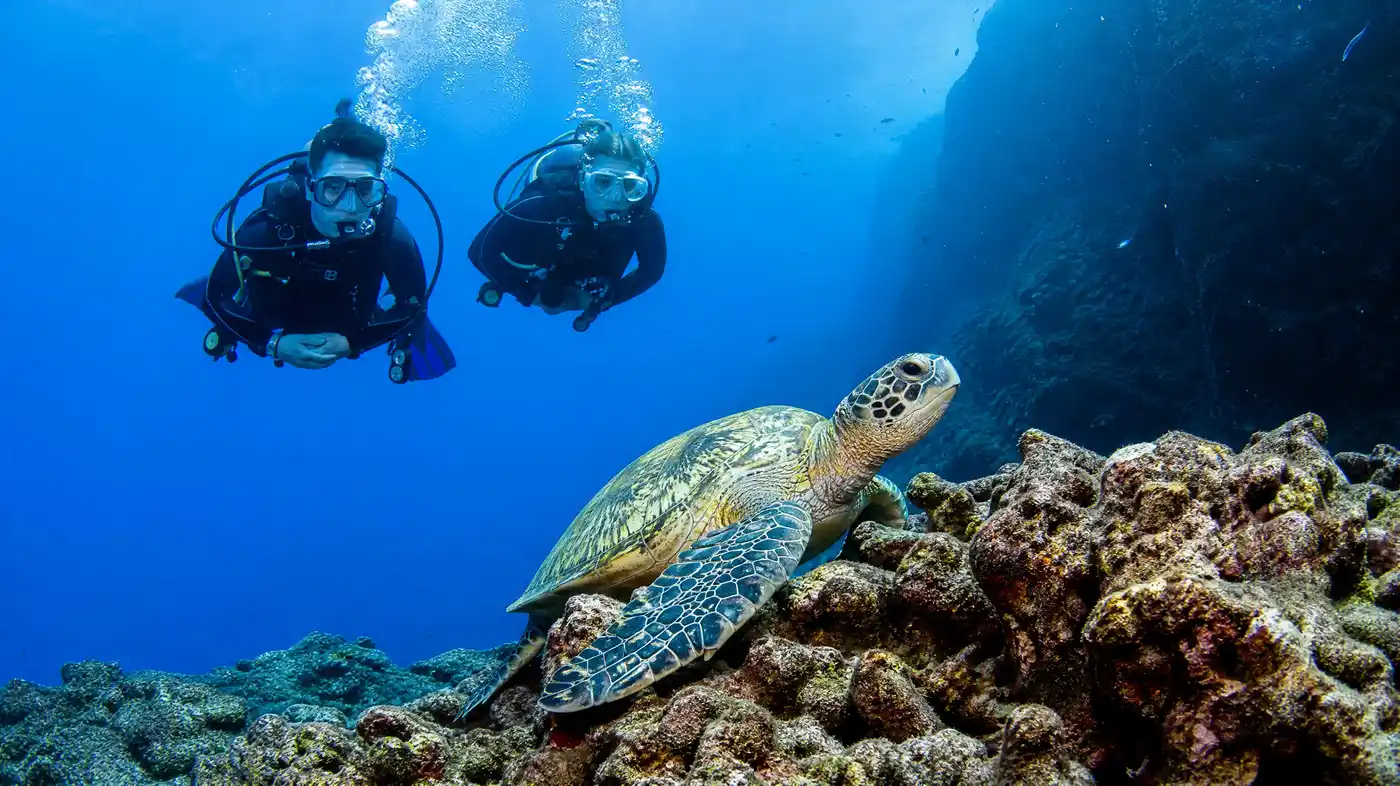
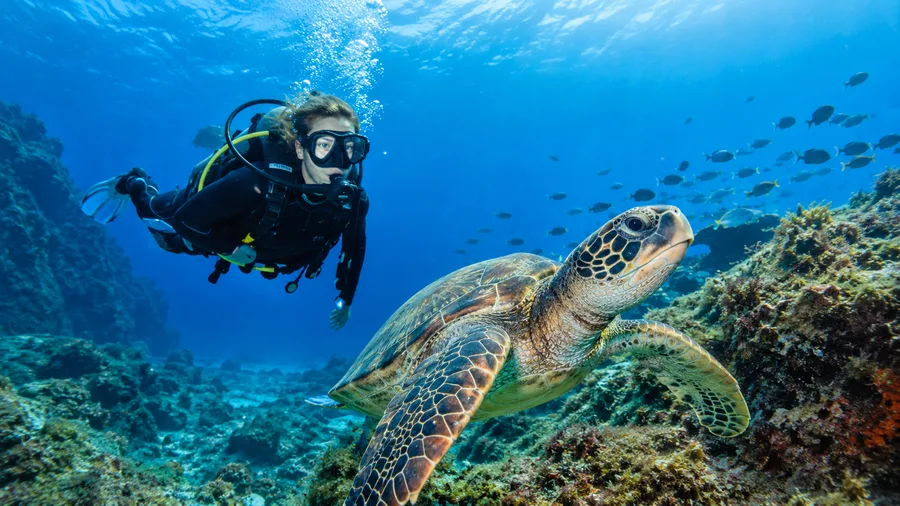
El Puertito gained fame over the years for its resident population of green sea turtles. If encountering tenerife scuba diving turtles is your primary dream, you should know that local authorities stopped dive boats from feeding them years ago, which was the right move for conservation. While you are no longer guaranteed a turtle swimming right into your mask lens, encounters still happen regularly along the southern shelf. Keep your hands to yourself if one glides past. Touching them strips the protective mucus from their shells and stresses them needlessly.
For a broader breakdown of coastal geography, read through this guide to scuba diving in South Tenerife and best dive sites, especially if you plan to venture out on a boat dive once your confidence settles.
Book your scuba diving tenerife experience:
Choosing Your First Dive Course: Try Dive vs Open Water
Deciding between a quick afternoon taster and a full multi-day course comes down to your vacation schedule and how much commitment you want to throw at a new hobby. A Try Dive takes about three hours of your holiday. A full Open Water Diver course requires three or four days, several pool or shallow-water training sessions, written quizzes, and an exam.
If you have never breathed off a tank, do not rush straight into the full course. Spend a morning doing a basic introductory dive first. Most dive shops will happily credit the fee of your introductory dive toward a full Open Water certification if you decide halfway through that you love it and want to keep going. That spares you the misery of paying upfront for an extensive four-day course only to realize on day one that clearing your ears gives you a headache.
| Program Type | Duration | Max Depth | Certification Earned | Typical Cost |
|---|---|---|---|---|
| Try Dive (Shore) | Half day | 6 meters | None (experience only) | €70 - €95 |
| Try Dive (Boat) | Half day | 10 to 12 meters | None (experience only) | €95 - €130 |
| Scuba Diver | 2 days | 12 meters | Supervised diver card | €260 - €310 |
| Open Water Diver | 3 - 4 days | 18 meters | Independent diver card | €390 - €480 |
Dive shops on the island are affiliated with either PADI or SSI. Both are internationally recognized, both follow strict safety standards, and you can dive anywhere in the world with either credential. For an honest look at what centers charge for gear hire and boat fuel, take a look at our breakdown of Tenerife scuba diving prices, schools, and packages before booking the cheapest place you find on social media.
What Your First Dive Feels Like and Practical Advice
The gear feels heavy on dry land. The steel cylinder weighs around 14 kilograms, plus the lead weights threaded onto your belt or tucked into your buoyancy pockets add another 6 to 8 kilos. You might feel clumsy stepping across gravel. The moment the water reaches your chest, all that weight vanishes. You become weightless.
Your ears will complain almost immediately as you descend past two meters. Water pressure pushes inward against your eardrum, creating a dull ache similar to an airplane landing. You must equalize early and equalize often. Pinch your nostrils through the silicone nose pocket of your mask and blow gently through your nose. You will feel a soft pop in both ears, and the pressure dissolves. If an ear refuses to clear, signal your instructor, swim up half a meter, and try again. Never force yourself downward while your ears hurt.
Pro tip: Start equalizing your ears the second your head drops beneath the surface, long before you feel any pressure or pain. Doing it every foot or two makes the descent effortless.
Here are a few habits that will make your first session much smoother:
- Breathe continuously: Never hold your breath underwater, even when you are concentrating hard on swimming or checking your gauge. Smooth, slow breaths keep your buoyancy stable.
- Kick from your hips: Avoid bending your knees like you are riding a bicycle. Long, slow flutter kicks from your hips let the broad blades of your fins push water without exhausting your thighs.
- Keep your hands still: Beginners instinctively dog-paddle with their hands. It does nothing except waste your oxygen and stir up sand from the seafloor; clasp your hands in front of your chest instead.
- Skip the heavy breakfast: Swallowing saltwater while learning regulator recovery on a stomach full of greasy fried eggs is a fast track to seasickness.
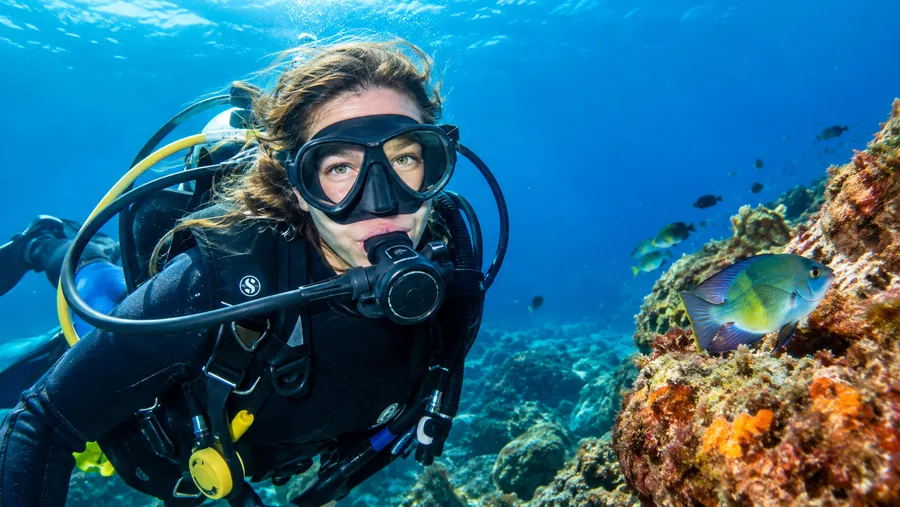
Marine life in the shallows is curious. Atlantic damselfish - dark navy blue with bright neon edges when young - dart in and out of rocks right around your mask. Banded seabream follow divers in small schools, hoping your fins kick up loose worms or small crabs from the sand. You might spot a cuttlefish hovering near the bottom, rippling through shades of brown and white like an underwater chameleon. It is peaceful down there in a way that is difficult to describe until you have spent forty minutes suspended in blue space.
Quick Reference
- Water temp: 19°C (Feb) to 24°C (Sep)
- Intro dive depth: 6 to 12 meters
- Typical intro cost: €75 - €110
- Certification time: 3 to 4 days
- Best beginner hub: Costa Adeje / Los Cristianos
Frequently Asked Questions about scuba diving tenerife for beginners
Is scuba diving in Tenerife scary for someone who has never tried it?
It can feel strange for the first three minutes because breathing underwater goes against human instinct. Once you take four or five calm breaths and realize your equipment works reliably, the initial anxiety drops away. Instructors in beginner areas stay directly beside you the whole time.
Will I see sharks during a beginner dive in Tenerife?
You will not encounter dangerous sharks. You might spot an angelshark lying camouflaged on the sandy bottom during winter or spring, but these are flat, docile bottom-dwellers related to rays that ignore divers completely unless stepped on.
Can I fly home right after my first dive?
No. You must wait at least 12 hours after a single introductory dive before boarding an airplane. If you complete multiple dives over a couple of days during a course, you need an 18 to 24 hour surface interval to allow residual nitrogen to leave your body safely.
Book your scuba diving tenerife experience:
The Bottom Line
Scuba diving looks complicated from the outside with all the hoses, gauges, and neoprene, but your first experience underwater is mostly about relaxing and letting the instructor do the heavy thinking. Tenerife offers warm enough water, incredible visibility, and hundreds of sheltered volcanic bays where you can test the waters at your own pace. If you are on the fence, book a simple shore-based Try Dive on a sunny morning. Floating weightless above black sand while schools of bream circle your fins is an experience you will not forget, and it might just start a lifelong obsession.
Read more about scuba diving tenerife.